

Understanding www.binary: A Beginner's Guide
Discover www.binary basics and how binary numbers & internet protocols shape tech today. Practical tips for South African users to master binary online 💻🌍
Edited By
Sophie Carlisle
Binary trees are one of the foundational structures in computer science, shaping how data is organised, searched, and manipulated. At their core, a binary tree is a set of nodes where each node has at most two children, commonly referred to as the left and right child. This simple rule gives rise to a diverse array of tree types and operations.
Understanding binary trees is especially useful for financial analysts and traders who deal with large volumes of data requiring efficient search and sorting methods. For example, portfolio databases or algorithmic trade logs can be structured with binary trees to achieve faster access times.

Most binary trees enable operations such as insertion, deletion, and traversal in logarithmic time, making them far more efficient than linear lists for large datasets.
Each node in a binary tree contains three elements:
Data: the actual information stored, such as a price point or transaction ID.
Pointer to left child: linking to smaller or earlier entries.
Pointer to right child: linking to larger or later entries.
This arrangement naturally supports hierarchical ordering. Picture a tree where every node divides the data set, so you narrow down searches by following left or right paths.
Full Binary Tree: Every node has either zero or two children.
Complete Binary Tree: All levels are fully filled except possibly the last, which is filled from left to right.
Perfect Binary Tree: Every level is fully occupied, no gaps.
Binary Search Tree (BST): Maintains sorted order where left child is less than parent and right child is greater.
In trading systems, BSTs are widely used for quick lookups of orders or price levels, cutting search times drastically compared to unsorted lists.
Investors and brokers often face performance bottlenecks when handling data like historical prices or client accounts. Binary trees empower:
Efficient Searching: Quickly locate a specific trade record or client without scanning the entire database.
Data Organisation: Arrange data sets hierarchically for reporting or risk assessments.
Algorithmic Trading: BSTs speed up decision-making processes based on live market data.
Binary trees are fundamental tools shaping the backbone of financial data systems, making them well worth understanding for anyone involved in data-intensive financial roles.
Binary trees form a fundamental pillar in computer science, serving as the backbone for organising and processing data efficiently. For traders, investors, and analysts who deal frequently with large datasets or require speedy search operations, understanding binary trees simplifies many complex tasks. These structures help manage hierarchical information and support algorithms that can swiftly locate, insert, or delete data.
A binary tree is a special kind of tree data structure where each node has up to two children, commonly referred to as the left and right child. This strict limit to two children per node makes algorithms more predictable and scalable, especially useful for storing sorted data and enabling fast search operations. For example, portfolio management software might use binary trees to efficiently store assets by their values or dates.
Each element in a binary tree is called a node, which contains data, such as a value or key. Nodes connect to each other through edges, representing the links between parent and child nodes. The topmost node is known as the root, serving as the entry point to the entire tree. This root is akin to the main branch on a money tree, from where all financial data branches out, making the root’s position critical in defining the tree’s structure and traversal.
Binary trees excel at organising data where quick search, insertion, and deletion are necessary. Unlike simple lists or arrays, where finding an item might mean sifting through every entry, binary trees can reduce this search space significantly. Imagine a stock trading platform needing to quickly identify a particular company’s shares; binary search trees allow rapid lookups rather than scanning entire datasets. This efficiency directly impacts software performance, user experience, and the speed of decision-making.
While binary trees restrict nodes to two children, other trees may allow many more, like B-trees commonly used in database indexing. Binary trees serve as the foundation for these more complex structures. Understanding binary trees makes it easier to grasp such variant trees and their applications. For instance, in financial algorithmic trading, binary trees form the core algorithm on which more sophisticated data structures are built to handle large-scale, real-time data.
In a nutshell, binary trees balance simplicity and performance, making them invaluable tools for handling hierarchical and sorted data quickly and reliably.
This section sets the stage for deeper exploration into the types, operations, and real-life applications of binary trees, all of which unlock potent ways to organise and manipulate data efficiently in various financial and computing contexts.
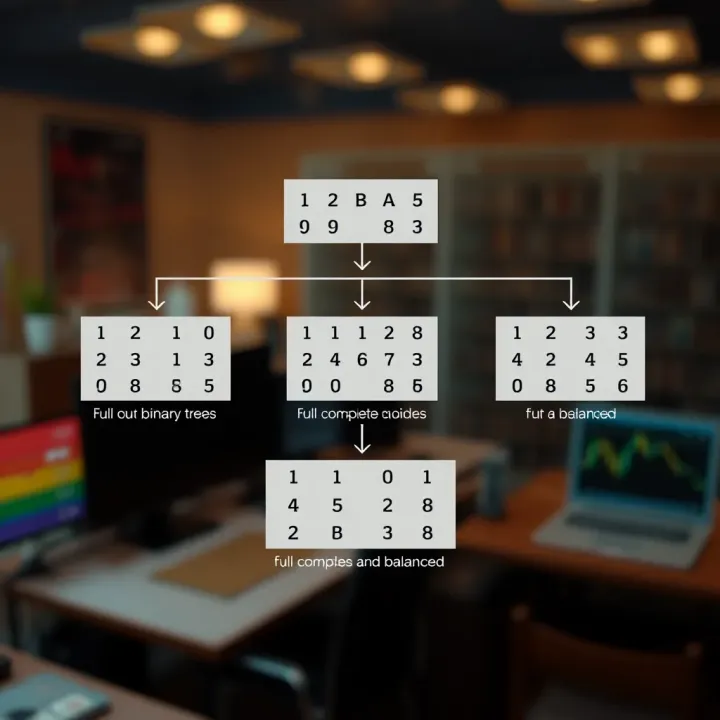
Knowing the different types of binary trees is key to understanding how to pick the right structure for your needs, especially in computing and finance where data organisation and retrieval speed matter. Various forms of binary trees come with distinct properties that influence how well they perform under different conditions. This section unpacks these types, helping you grasp what they mean and when to use them.
Full and complete binary trees are closely related but have subtle differences with practical implications. A full binary tree is one where every node has either zero or two child nodes. No node in a full binary tree has a single child, which keeps the structure tidy and predictable. By comparison, a complete binary tree is filled level by level, left to right, except possibly the last level. This ensures minimal gaps in the arrangement, improving storage efficiency.
These trees often find use in scenarios like binary heaps, commonly used to implement priority queues where quick access to the highest or lowest priority item is critical. The complete structure allows the heap to be stored efficiently in an array without wasted space, reducing overhead in financial applications that prioritise fast access to changing data.
A perfect binary tree is a special case where all interior nodes have exactly two children, and all leaves appear on the same level. This symmetry means all levels are perfectly filled, making calculations for node count or height straightforward. If a perfect binary tree has a height of h, it has exactly 2^(h+1) - 1 nodes.
Algorithmically, perfect binary trees simplify traversals and recursive operations since the structure is uniform. They allow balanced workloads in parallel processing or dividing tasks, which can be helpful when analysing stock market data or financial risk models. Their predictability makes them ideal when consistent performance is necessary.
Balanced binary trees aim to keep their height as small as possible to maintain quick search, insertion, and deletion times—roughly O(log n) in complexity. Examples include AVL and Red-Black trees, which automatically rebalance themselves. Keeping a tree balanced means operations like stock lookup or transaction insertion happen swiftly even as the dataset grows.
On the flip side, a degenerate binary tree behaves like a linked list, where each parent has only one child. This situation often arises from inserting sorted data without balancing. Degenerate trees suffer from poor performance, with operations degrading to O(n), making them unsuitable for finance where quick lookups spell the difference between profit and loss.
Maintaining the right tree structure is not just academic—it directly influences how quickly data can be accessed or updated, impacting decision-making speed in high-stakes environments like trading floors.
By understanding these binary tree types and their features, you can better design or select data structures that meet local requirements, optimise for speed, and manage resources effectively.
Binary trees play a significant role in managing and storing data efficiently, especially when it comes to operations such as traversal, insertion, deletion, and search. Understanding these operations helps you manipulate tree structures effectively, which matters a lot in coding tasks related to databases, financial algorithms, and decision-making systems. These operations ensure that binary trees maintain their structure while facilitating quick access and updates.
Traversal means visiting every node in the binary tree in a systematic way. This is central when you want to access or process the values stored in the tree.
In-order traversal visits nodes starting from the left subtree, then the parent node, followed by the right subtree. This approach is especially useful when you want to retrieve data in sorted order from binary search trees. For example, if you have a binary tree representing stock prices sorted by date, an in-order traversal will list these prices chronologically.
Pre-order traversal visits the parent node first, then the left and right subtrees. This is handy when you need to duplicate a tree or save its structure before processing. Say you want to export a decision tree’s structure for investment strategies; pre-order traversal helps capture the workflow from top decisions to detailed branches.
Post-order traversal processes nodes by visiting left and right subtrees first, then the parent node. This method is useful for deleting trees safely because it removes children nodes before their parent, avoiding orphaned nodes. Additionally, it's commonly used in expression evaluation where operators come after their operands, such as calculating the value of financial formulas stored in tree form.
Level-order traversal visits nodes level by level, from the root downwards. This is useful when you want to monitor or inspect the tree gradually, like reviewing layered decision-making processes in a risk assessment tool. It’s typically implemented using a queue to ensure all nodes at the same depth get processed before moving deeper.
Adding nodes to a binary tree must keep the tree’s properties intact. For binary search trees, new nodes get placed based on their value relative to existing nodes. For instance, when inserting new transaction data into a financial ledger structured as a binary search tree, you’d place the entry either to the left or right depending on the date or amount. This keeps lookups fast and predictable.
Removing nodes requires caution to maintain tree structure. When a node with children is deleted, it’s replaced either by its in-order predecessor or successor to fill the gap smoothly. For example, deleting an outdated stock record from a binary search tree means you must reposition nodes so that the order remains intact and future searches don’t break.
A simple linear search goes through nodes one by one, which can be slow with large trees. In contrast, binary search exploits the tree’s sorted nature to halve the search area at every step, significantly accelerating lookup times. Imagine a trader needing to find a specific price point within millions of records; binary search helps narrow down the target quickly.
Binary search trees are designed for efficient lookups because of their ordered layout. Each node splits the data into subsets, guiding searches left or right depending on the value sought. This makes operations like checking stock prices or market trends far faster than scanning an unstructured list.
Efficient binary tree operations optimise data handling, making them vital in fast-paced financial environments where every millisecond counts.
In sum, mastering these core operations on binary trees equips you with robust tools to handle data structures, enabling smoother, quicker computations vital for trading, portfolio management, and algorithmic decision-making.
Binary trees play a pivotal role in various computing problems, especially in organising data and processing information efficiently. Their branching structure naturally fits the way computers handle hierarchical relationships, which makes them invaluable for sorting, searching, expression parsing, and decision making. For traders, investors, and financial analysts, understanding these applications helps unlock better data handling and faster computations.
Binary search trees (BSTs) maintain a sorted data set by enforcing a simple ordering rule: every node’s left child contains a smaller value, and the right child contains a larger value. This organisation makes BSTs intuitive for storing and maintaining sorted lists, which is essential in financial databases or real-time market feeds where quick insertion or deletion of entries matters. For example, when tracking share prices dynamically, BSTs allow rapid updates without having to re-sort entire datasets.
Using a BST for searching can drastically cut down the time spent compared to linear searches through an unsorted list. Typically, BST search operations run in logarithmic time (O(log n)) when the tree is balanced. This means looking up a company’s stock price in a large index happens much faster. BSTs also facilitate efficient sorting by performing an in-order traversal that visits nodes in ascending order, handy for reporting or analysis tasks where sorted outputs are required.
Binary trees simplify the representation of arithmetic expressions by holding operators as internal nodes and operands as leaf nodes. This means complex calculations, such as those involved in financial modelling or risk assessment, can be structured in a tree format where each subtree represents a part of the expression.
To compute the final result of an expression, tree traversal methods like post-order traversal are used effectively. This approach processes subexpressions before applying an operator, mimicking how humans solve calculations step-by-step. Automated systems analysing market formulas or financial derivatives pricing benefit from this structured evaluation method, ensuring accuracy and clarity in calculations.
Decision trees are binary trees tailored for decision-making processes. Each node represents a test or decision criteria, splitting data based on attributes to guide toward final classifications or predictions. For instance, an algorithm evaluating creditworthiness might use a decision tree that asks about income, existing debt, and repayment history to decide on loan approval.
In machine learning, decision trees help classify data into categories, making them valuable for tasks like fraud detection or client segmentation in financial services. Their visual and interpretable nature allows analysts to trace how decisions are made, fostering trust in automated systems. Also, because decision trees can handle both categorical and continuous data, they fit a wide range of financial modelling challenges.
Binary trees, across these applications, offer both organisational and computational advantages that improve how financial data is managed and interpreted. Their versatility makes them a must-know for anyone working with complex datasets or decision models in the financial sector.
Binary trees, while foundational in organising data efficiently, come with their own set of challenges. Handling these effectively ensures performance doesn’t take a nosedive, especially in demanding applications such as financial databases or real-time trading platforms. Balancing the tree’s shape and managing memory usage are two critical factors that impact the speed and scalability of operations.
A balanced binary tree keeps the height minimal relative to its number of nodes, which directly affects lookup, insertion, and deletion speeds. If a tree becomes skewed—think of it like a badly organised filing cabinet where everything piles up on one side—these operations degrade from typically logarithmic time to linear time. That’s a big deal in finance, where milliseconds count and data volumes can be huge.
To maintain this balance, structures like AVL (Adelson-Velsky and Landis) trees and Red-Black trees are widely adopted. AVL trees strictly track balance by keeping height differences between left and right subtrees to at most one, rotating nodes as necessary after insertions or deletions. This guarantees faster search times but comes with some overhead when maintaining strict balance.
Red-Black trees, on the other hand, allow a bit more flexibility in balance but use colour properties to maintain a form of balanced tree with less frequent rebalancing. This makes them popular in systems like Linux kernels or certain libraries where a good balance between speed and simplicity matters. Both techniques show how a bit of extra bookkeeping upfront can pay off in faster, more reliable data handling downstream.
The trade-off between memory use and performance is a key consideration in binary tree implementations. Storing pointers for each node (to its children and sometimes to its parent) increases memory usage but speeds up traversal and updates. For vast datasets, careful structuring can reduce overhead, for example by redesigning nodes to hold only necessary pointers or by using array-based representations where appropriate.
However, squeezing memory might come at the cost of slower operations. For instance, representing a tree as a linked structure offers flexibility but has greater memory overhead per node. Conversely, using an array representation—ideal for perfect or complete binary trees—enables faster index-based access but struggles with dynamic updates where nodes are frequently inserted or removed.
Balancing memory efficiency with performance needs calls for understanding your specific application context—what works for a static dataset might bog down under heavy updates or vice versa.
Ultimately, recognising these challenges and applying smart optimisation methods can make a significant difference. Whether for a financial analysis tool or a stock monitoring system, optimised binary trees provide faster data retrieval and manipulation, enabling more responsive and reliable applications.
Discover www.binary basics and how binary numbers & internet protocols shape tech today. Practical tips for South African users to master binary online 💻🌍

🔢 Learn how to convert hex to binary step-by-step, explore essential number systems, practical uses in computing, and tips for accuracy and speed—ideal for tech enthusiasts in South Africa.

🧮 Discover how to convert Gray code to binary easily! Learn key differences, step-by-step methods, and real-life applications in digital systems.

📊 Discover how free binary signals work and where to find reliable ones in South Africa. Learn to spot scams and improve your binary trading strategy wisely.
Based on 5 reviews