

Top Books for Forex Trading in South Africa
📚 Discover essential forex trading books packed with practical tips, risk management, and trader psychology for South Africans aiming to improve skills and profits.
Edited By
Charlotte Emerson
Starting your journey into forex trading can feel overwhelming with the number of resources out there. The currency market operates 24/5, shifting constantly with global economic events, making solid knowledge essential. That's where the right books come in — offering clear guidance on strategies, risk, psychological resilience, and technical analysis.
The forex market isn’t just about guessing directions; it demands a combination of analysing charts, understanding economic indicators, and managing emotions during volatile swings. A well-chosen book can save you countless hours and costly mistakes by explaining concepts through practical examples and tested methods.

For instance, a trader who understands how to interpret candlestick patterns and combine them with fundamental news is more likely to spot reliable entry points. Similarly, grasping risk management techniques, such as position sizing and stop-loss orders, helps shield your capital against unpredictable moves. On top of that, cultivating the right mindset to handle losses without panic is just as vital.
"Forex trading is a marathon, not a sprint. The tools and wisdom you gather early on will carry you through tougher market moments."
Books serve as your reference library—once you know a topic, you can revisit it as needed. Unlike quick online tips, they tend to provide in-depth understanding. When browsing South African traders’ favourite titles, you'll often find a mix that covers:
Trading strategies based on technical and fundamental analysis
Risk management fundamentals tailored to preserve capital
Psychology of trading, focusing on discipline and emotional control
Real-life case studies and chart examples
In short, the essential books on forex trading aren’t meant to make you an overnight millionaire but to give you a sturdy foundation. Whether you’re a newcomer keen on grasping the basics or a seasoned trader trying to sharpen a specific skill, these resources can sharpen your approach and build confidence to navigate the busy forex exchanges from Johannesburg to London and beyond.
Grasping the basics of forex trading lays the foundation for any trader hoping to succeed in this fast-moving market. Without a clear understanding of how currency pairs work, how exchange rates are set, and when the market operates, traders may find themselves out of their depth quickly. This section aims to clarify these elements, helping you get a solid footing before exploring more complex strategies.
Forex trading involves buying one currency while simultaneously selling another, which is why currencies are quoted in pairs, such as EUR/USD or ZAR/USD. Each pair consists of a base currency and a quote currency. For example, in the pair USD/ZAR, if the rate is 17.50, it means one US dollar equals 17.50 South African rand. Understanding this concept is essential because every trade revolves around anticipating whether the base currency will strengthen or weaken against the quote currency.
Market participants include banks, central banks, hedge funds, corporations, and retail traders like you. Banks and financial institutions often execute large trades, influencing liquidity and volatility, while retail traders generally operate smaller volumes but collectively contribute substantially to the market’s activity.
Exchange rates fluctuate constantly due to supply and demand forces, influenced by factors like economic data releases, geopolitical events, interest rate changes, and market sentiment. For instance, if South Africa’s Reserve Bank raises interest rates while the US Federal Reserve holds steady, the rand might strengthen against the dollar, impacting the USD/ZAR pair.
Understanding what moves exchange rates helps traders make informed decisions rather than guessing blindly. It’s worth noting that forex prices also reflect expectations about future economic conditions, not just current ones. This forward-looking nature adds complexity that must be appreciated early on.
The forex market operates 24 hours a day during the working week, opening in Asia, then Europe, and finally North America. This continuous cycle means there’s almost always a chance to trade, but liquidity and volatility vary across sessions.
Liquidity tends to peak during the London and New York sessions when major financial centres overlap. For example, the USD/ZAR market is notably active from 9 am to 2 pm SAST, offering tighter spreads and better execution. Knowing when to trade can save costs and improve outcomes.
Beginner traders should look for books that break down forex concepts into manageable chunks, use clear language without jargon overload, and include practical examples relevant to real-world trading. A good beginner book often starts with the basics, progresses logically, and avoids assuming prior financial knowledge.
Moreover, guides that provide exercises, quizzes, or demo trading suggestions can help reinforce learning. After all, theory without practice leaves gaps.
Forex can feel overwhelming with technical indicators, economic theories, and psychological challenges mixed in. The best beginner books simplify these without dumbing down content. They focus on essentials — like support and resistance, candlestick patterns, and risk management — that every novice should absorb before chasing profits.
Books that use stories, analogies, or relatable trading scenarios make abstract ideas tangible. For instance, comparing market sentiment to public opinion during an election can clarify why prices react to news.
Some well-regarded books for new forex learners include Currency Trading for Dummies by Brian Dolan, which offers a clear, approachable introduction with practical tips. Another is The Little Book of Currency Trading by Kathy Lien, appreciated for its straightforward style and useful market insights.
These resources stand out for their balance of theory and practice, making them a solid starting point before advancing to more specialised strategy or psychology texts.
Starting with the right foundational knowledge saves time and frustration — your trading journey begins by understanding what makes forex tick and choosing resources that respect your learning pace.
Trading strategies form the backbone of successful forex trading. Books that focus on these strategies offer traders a deeper understanding of different approaches and how to apply them in real market situations. These guides equip readers with practical methods to identify, build, and refine trading plans tailored to their risk tolerance and market conditions.

Trend following and breakout strategies are among the most widely used trading methods. Trend following involves identifying a market direction and taking positions in line with that trend, hoping the momentum carries the price further in the same direction. Breakout strategies focus on catching price movements when the market breaks through key support or resistance levels. Both approaches depend on recognising significant market signals and can be particularly useful in the foreign exchange market, which often experiences strong directional moves during busy trading sessions.
Range trading and reversal patterns are suited to markets that lack clear direction and move within defined price bands. Traders using range strategies buy at support and sell at resistance, aiming to profit from predictable oscillations. Reversal patterns indicate potential turning points where a trend may end, and an opposite direction might start—such as Double Tops or Head and Shoulders patterns. Understanding these patterns helps traders avoid false signals and capitalise when the market shifts.
Scalping and day trading techniques involve high-frequency trades aiming to capture small profits from short-term price changes. Scalpers enter and exit positions quickly, often holding trades for minutes or seconds. Day traders close all positions before the day ends to avoid overnight risk. These techniques require strict discipline, quick decision-making, and the ability to manage transaction costs effectively.
Books that focus on building and testing strategies teach traders how to construct a plan based on clear entry and exit rules. They often advocate for backtesting strategies on historical data to evaluate their effectiveness before applying them live. This approach minimises guesswork and helps traders refine their methods systematically.
Adapting strategies to changing markets is essential for long-term success. No single strategy works forever, so books that discuss how to modify or combine approaches in response to volatility, economic news, and shifting trends can give traders an edge. These resources often highlight the importance of continuous learning and flexibility.
Well-regarded guides such as "Trading for a Living" by Dr Alexander Elder or "Forex Price Action Scalping" by Bob Volman cover a range of practical strategies and offer insights into testing and adapting trade plans. These books combine theory with real-life examples, giving readers actionable advice that moves beyond surface-level explanations.
Strong strategy books teach not only specific techniques but also how to think critically about the market, helping traders evolve rather than rely on fixed rules.
In summary, focusing on strategy-oriented trading books helps forex traders develop a tailored approach that considers market nuances and personal preferences. This foundation is key to navigating the forex market effectively and managing risk while aiming for consistent profits.
Technical analysis forms the backbone of many successful forex trading approaches. Mastering it through well-chosen books can sharpen your ability to read the market's language—price action, chart patterns, and indicators. These books can give you the tools to make sense of complex market movements and help identify the right opportunities to enter or exit trades.
Charts, indicators, and patterns are the essentials you'll encounter right away. Charts display price movements over time, and learning how to interpret these — whether candlestick, line, or bar charts — is fundamental. Indicators like Moving Averages or the Relative Strength Index (RSI) offer quantitative insight into trends and momentum. Patterns, such as head and shoulders or flags, can signal potential reversal or continuation points. Together, these tools help you understand market sentiment and timing more clearly.
Support, resistance, and trend lines act like invisible boundaries and guides in price action. Support is where price tends to stop falling and bounce upwards, while resistance is where rising prices often stall or reverse. Drawing trend lines connects price highs or lows and helps determine the prevailing market direction. For instance, spotting a break above a well-established resistance line could hint at a bullish surge ahead. Knowing how to spot these can prevent costly mistakes, such as entering trades against the main trend.
Role of volume and momentum analysis can seem tricky, but it provides extra confirmation, which is crucial. Volume tells you how much trading activity happens during a price move—a spike in volume during price rise shows strong interest behind the move. Momentum indicators help gauge the speed and strength of price changes, alerting traders to potential shifts before they happen. For example, the Moving Average Convergence Divergence (MACD) can identify when momentum is weakening, signalling possible reversals.
Guides for understanding chart reading lay the foundation for any serious forex trader. Books that introduce chart basics, such as candlestick formations and price patterns, let traders spot setups in real market conditions. For example, "Japanese Candlestick Charting Techniques" by Steve Nison reveals how visual patterns on charts hint at future price moves, a skill invaluable for those wanting to dive deeper.
Books on indicator application focus on how and when to deploy tools like Bollinger Bands, Fibonacci retracements, or stochastic oscillators. These resources explain practical uses and limitations, emphasizing the importance of combining indicators rather than relying on any single one. Reading such books can help avoid the trap of becoming an "indicator junkie" and instead use these tools with strategy and purpose.
Practical examples and case studies bring theory to life. Texts that walk you through actual market trades, explaining thought processes and mistakes, boost your learning curve substantially. They show how technical analysis reacts during real events, such as sudden economic data releases or geopolitical tensions, which often cause wild price swings in the forex market.
Learning technical analysis from books is more than memorising indicators; it's about developing an intuition for market behaviour grounded in clear, proven methods. In South Africa, where market dynamics can be influenced by global and local factors, this knowledge equips traders with a solid edge.
By focusing on these aspects, you’ll be better prepared to read the signs the market provides and approach forex trading with more confidence and clarity.
Risk management is often the unsung hero of successful forex trading. While mastering strategies and indicators grabs most attention, understanding how to control and limit losses is what keeps traders afloat over the long haul. Books focused on risk management provide vital lessons on balancing potential gains against possible losses, helping you avoid blowing your trading account on a single position gone wrong.
Managing exposure and position sizes is fundamental for anyone serious about forex trading. Essentially, it means deciding how much of your capital to put on each trade, depending on your comfort with risk and the size of your account. For example, risking 1% of your trading capital per trade is a common practice to prevent substantial losses from wiping you out. Without this discipline, a few bad trades could drain your funds quickly, especially in a market as volatile as forex.
Setting stop-loss and take-profit levels is another key tool in managing risk. A stop-loss order automatically closes a trade when the price moves against you beyond a set point, limiting further losses. Conversely, a take-profit order secures your gains when the price hits a favourable target. Both help enforce discipline, preventing emotional decisions that often lead to bigger losses or missed profits. For instance, a trader who sets a stop-loss 50 pips below entry on EUR/USD and a take-profit 100 pips above is effectively aiming for a reward-to-risk ratio of 2:1, a sensible risk plan.
Handling leverage responsibly is critical because forex brokers offer leverage that can multiply both gains and losses. Using high leverage without a strong risk management plan can lead to rapid account depletion. Think of leverage as a double-edged sword: while it can boost returns, it also magnifies losses. Literature on risk management often stresses using leverage conservatively, especially for newcomers. For example, a 1:30 leverage on a R10,000 account allows control over R300,000 worth of currency — but the risks involved mean you should avoid maxing out this potential exposure.
Books highlighting risk vs reward concepts break down how to calculate potential profits against possible losses before entering a trade. Understanding risk/reward ratios helps you pick only those trades where the potential gains justify the risks. Such books guide you in developing rules to avoid low-reward trades and consistently seek opportunities with favourable ratios. This mindset often separates casual gamblers from disciplined traders.
Strategies to protect trading capital include prudent money management, diversification of trades, and using protective orders. Many titles cover how to set sensible limits on losses over a day or week, effectively managing your overall forex exposure rather than just individual trades. For instance, implementing a daily loss limit (say 2% of your capital) helps prevent emotional chasing of losses and encourages stepping away when the market isn’t favourable.
Case examples of risk management successes and failures provide practical insights by analysing real-life trading scenarios. These stories reveal costly mistakes such as ignoring stop-losses or overleveraging, alongside success tales where conservative risk controls saved traders during market shocks. Learning from such cases helps readers internalise the importance of risk management and avoid common pitfalls themselves.
Effective risk management isn’t just about protecting your trading account; it’s about surviving long enough to see your strategies bear fruit. Reading books dedicated to this topic equips you with tools to stay in the game and trade with confidence.
By investing time in risk management literature, you build a solid foundation that supports all other trading skills. Without control over risk, even the best strategies can quickly falter — so make this area a priority on your learning journey.
Understanding trading psychology is just as vital as grasping charts or strategies in forex trading. The mind often becomes both your greatest asset and biggest hurdle. Books focusing on trading psychology offer insights into managing emotions, avoiding mental traps, and maintaining a disciplined approach. They supply traders with the tools to navigate the psychological storms that inevitably arise in volatile markets.
Fear and greed are perhaps the two most common emotions that trip up traders. Fear can cause hesitation or premature exits, often resulting in missed opportunities, while greed might push traders to take excessive risks or hold onto losing positions for too long. For example, a trader seeing rapid price swings may panic and close a trade out of fear, missing the chance for a reversal. Recognising these emotions is the first step to managing them effectively.
Forex trading demands a strong sense of discipline and patience. Sticking to your trading plan, even when the market is unpredictable, avoids impulsive decisions. Patience becomes crucial, especially when waiting for ideal trade setups or allowing profitable trades to mature. Without this, traders often end up chasing the market or overtrading, which can deplete capital quickly.
Cognitive biases like confirmation bias or loss aversion colour how traders interpret market information, often leading to faulty decisions. For instance, confirmation bias might cause a trader to focus only on data that supports their position, ignoring red flags. Being aware of these biases helps traders implement objective analysis rather than subjective gut feelings.
Books that teach emotional control provide practical strategies such as mindfulness, journaling, and breathing exercises tailored for traders. These techniques help calm the mind amidst market turbulence. A practical example is keeping a trading journal to note not only trades but emotional states, helping identify patterns and triggers over time.
Reading about resilience-building helps traders recover from inevitable losses, maintaining confidence without becoming reckless. Some books share stories of traders who bounced back after major setbacks, illustrating how mental toughness develops. Resilience isn’t about avoiding losses but managing their impact on future decisions.
Successful traders often adopt habits that maintain mental sharpness and objectivity, such as routine self-review, continuous learning, and detachment from single trade outcomes. Books highlighting these habits guide readers in forming a reliable mindset. They stress that consistent success in forex comes from steady, daily mental practice rather than chasing quick wins.
Mastering the psychological aspects of forex trading isn’t a one-off task. It requires ongoing effort, reflection, and adjustment. Reading well-regarded psychology books equips you with tools to stay focused, calm, and disciplined through the ups and downs of trading life.
Reading forex trading books is a solid foundation, but the real growth happens when you start applying that knowledge practically. This section offers some straightforward tips on how to use books effectively to actually improve your trading.
A demo account is the closest you’ll get to real forex trading without risking actual money. These accounts use simulated funds but replicate live market conditions. When reading about strategies or risk management, try them out immediately on a demo account to see how they work in practice. For instance, if a book explains a breakout strategy, practice spotting breakouts and executing trades on your demo first before going live. This hands-on approach cements theory into real skills.
Books often cover different styles like scalping, day trading, swing trading, or position trading. As you absorb this information, take note which approach fits your personality, risk appetite, and available time. For example, if you can only trade in your evenings after work, you might prefer swing or position trading over scalping. Testing these styles in a demo account can clarify what clicks for you before committing real funds.
Forex markets never stop evolving, so neither should your education. Books provide excellent groundwork, but supplementing them with market updates, fresh research, and expert insights will keep your knowledge current. Think of books as the base camp; keep climbing by following reputable blogs, podcasts, or newsletters tailored for forex traders.
Interactive courses and live webinars offer a dynamic learning experience. They provide opportunities to ask questions and watch real-time trade demonstrations. Many local brokerage platforms and training providers run courses specific to South African market conditions, which can add further value beyond what books cover.
Engaging with fellow traders in forums or social media groups can provide practical perspectives and tested tips you won’t find in books. Communities like Forex Factory or local Facebook groups allow you to discuss strategies, share trade ideas, and stay motivated. Just be cautious about unverified advice and always cross-check with solid sources.
Forex prices react instantly to global news – from central bank decisions to geopolitical events. Follow reliable sources such as Reuters, Bloomberg, or Business Day. South African traders should also track local economic data, interest rate announcements by the South African Reserve Bank (SARB), and geopolitical shifts affecting the rand. Staying informed helps you interpret what you read in books within the current market context.
Practical use of forex books involves blending knowledge with action and community input. The best traders keep learning by doing, discussing, and staying sharp with up-to-date news.
By combining these practical habits with solid reading, you’ll move from knowing forex theory to becoming a confident, adaptable trader.
📚 Discover essential forex trading books packed with practical tips, risk management, and trader psychology for South Africans aiming to improve skills and profits.

Learn where and how to master forex trading in South Africa 🇿🇦 with top courses, trusted mentors, key platforms, and smart risk strategies 📈💡

Looking to learn forex trading in South Africa? 📈 Discover top platforms, smart tips, and practical steps to build your skills and trade with confidence.
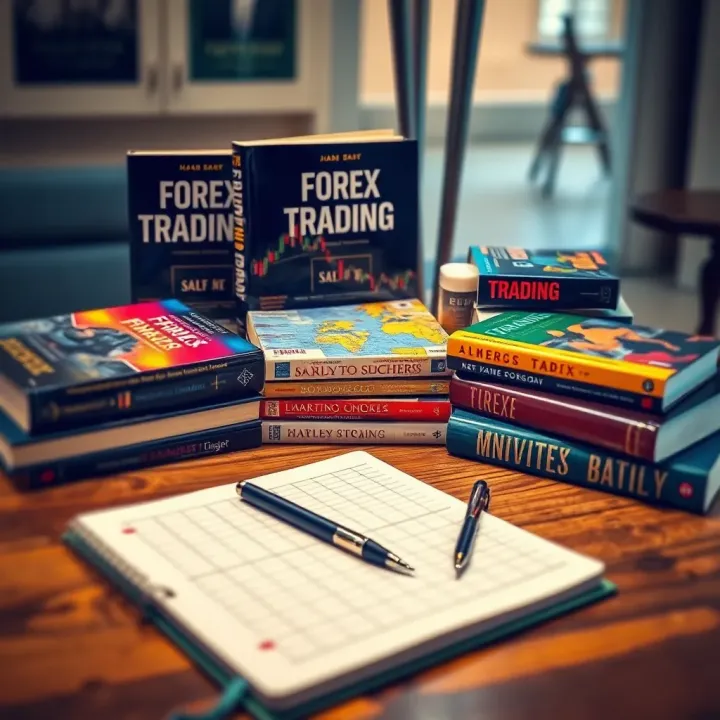
📚 Master forex trading in South Africa with top books on basics, strategies & picking the best reads to boost skills alongside other learning tools. 🇿🇦
Based on 11 reviews