

Understanding Gray Code to Binary Conversion
🧮 Discover how to convert Gray code to binary easily! Learn key differences, step-by-step methods, and real-life applications in digital systems.
Edited By
Daniel Hargreaves
Understanding how to convert decimal numbers into binary is not just a neat trick; it's a practical skill in today's digital world, particularly for anyone involved in computing or finance. Decimal numbers form the basis of everyday counting—our usual 0 to 9 system—while computers use binary, which relies solely on zeros and ones to process data. Grasping this conversion helps traders, analysts, and financial professionals better appreciate how information flows at the core of digital systems.
Binary numbers are simply representations in base-2, whereas decimal numbers operate in base-10. For instance, the decimal number 13 translates to 1101 in binary. This shift from one system to another enables computers to carry out complex calculations with simple electronic switches, representing off (0) and on (1) states.

Knowing decimal to binary conversions demystifies the way digital data and financial algorithms process numbers.
Many trading platforms and financial software rely on binary-coded computations behind the scenes. Understanding binary allows you to better interpret data formats, troubleshoot issues in algorithms, or even appreciate how digital encryption works to keep your transactions secure.
Here’s a simple way to convert a decimal number like 25 into binary:
Divide 25 by 2. The quotient is 12, remainder 1.
Divide 12 by 2. The quotient is 6, remainder 0.
Divide 6 by 2. The quotient is 3, remainder 0.
Divide 3 by 2. The quotient is 1, remainder 1.
Divide 1 by 2. The quotient is 0, remainder 1.
Write the remainders in reverse order: 11001 — that's the binary equivalent of 25.
Understanding these basic steps helps in deeper domains like coding, logic design, and data transmission.
For busy professionals, quick conversion tools and calculators can speed up the process, but knowing the fundamentals offers an edge when interpreting raw data or verifying results.
This foundation sets you up for mastering more complex digital concepts, giving you confidence navigating finance and tech fields where numbers are more than just figures — they're code.
Understanding numbering systems lays the groundwork for grasping how data is represented in everyday machines and financial systems. The two primary systems at play – decimal and binary – serve very different purposes but are intimately connected. Traders, investors, and financial advisers often deal with numbers daily, so recognising how these systems work can sharpen their understanding of computing fundamentals behind their tools.
The decimal system uses ten digits, from 0 to 9, which form the basis of all numbers we commonly encounter. Every number in this system is a combination of these digits. For example, the number 425 consists of digits 4, 2, and 5. This simplicity makes decimal numbers very accessible and intuitive – something our minds get used to from early education.
The decimal system operates on a base-ten structure, meaning each place value represents a power of ten. For instance, in the number 735, the 7 stands for 7 times 10 squared (700), the 3 for 3 times 10 to the power of one (30), and the 5 for 5 times 10 to the zero (5). Understanding this helps when dealing with currency amounts, stock prices, or percentages in South African markets.
Decimal numbering is standard in almost every facet of everyday life – from counting money, measuring distances in kilometres, to dispensing fuel in litres at petrol stations across Gauteng or the Western Cape. This common use means most people don't question it, yet behind the scenes, financial software or trading platforms convert these figures into binary for processing.
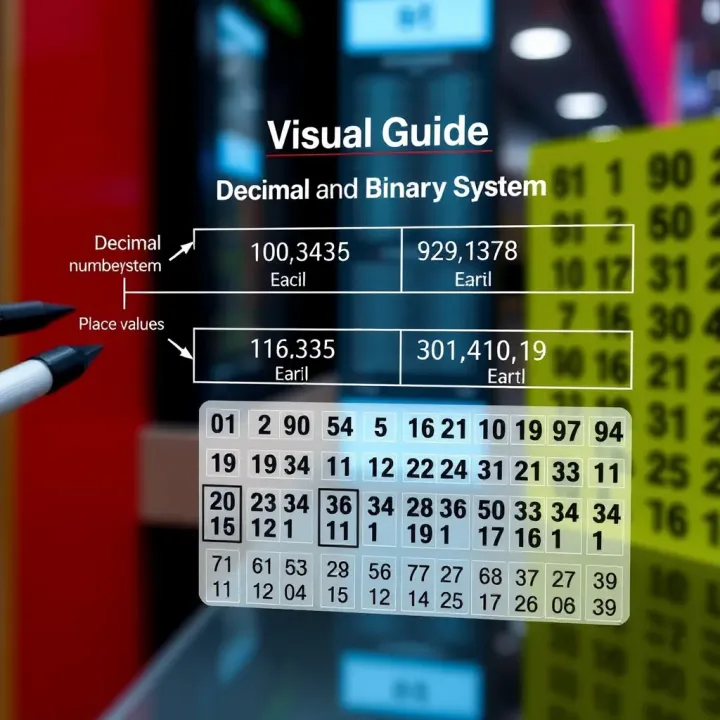
The binary system breaks away from decimal's complexity by using only two digits: 0 and 1. This simplicity makes binary ideal for electronic circuitry, which recognises on and off states. For example, the binary number 1011 represents a sequence of bits where each digit is either an electrical pulse or a pause.
Every device, from your smartphone to the trading terminals at the Johannesburg Stock Exchange (JSE), relies on binary to process information. Computers translate decimal figures into binary to execute calculations, store data, and run applications smoothly. Without this system, digital technology as we know it simply wouldn't function.
Unlike decimal, where each place value escalates by a factor of ten, binary place values increase by powers of two. This means that the binary number 101 represents 1×2² + 0×2¹ + 1×2⁰, which equals 5 in decimal. This fundamental difference affects how numbers are stored and manipulated in computing.
Knowing these two systems and how they intertwine allows financial experts and analysts to better understand the technology behind data management, trading platforms, and algorithmic processing.
By connecting daily decimal use with the behind-the-scenes binary workings, this overview prepares you for deeper insights into decimal-to-binary conversion and its significance in your financial toolkit.
Converting decimal numbers to binary is a fundamental skill, especially for traders and analysts dealing with digital systems or algorithmic models. Computers operate in binary, so understanding how to translate familiar decimal numbers into this format helps demystify processes like data encoding and programming logic. The conversion process provides a practical link between everyday numbers and the digital world underpinning modern finance and technology.
This method involves dividing the decimal number repeatedly by two and noting the remainders. Each division step yields a remainder of either zero or one, which directly corresponds to individual binary digits (bits). The remainders collected from bottom to top form the binary equivalent. It’s a straightforward technique that can be done with pen and paper, making it accessible to anyone.
Reading the binary digits goes from right to left, meaning the first remainder taken forms the least significant bit (the rightmost digit), while the last remainder recorded forms the most significant bit (the leftmost digit). This order is critical as it affects the final binary number’s accuracy.
For example, converting the decimal number 13 using this method starts by dividing 13 by 2, giving a quotient of 6 and remainder 1. Keep dividing the quotient by 2 until it reaches zero:
13 ÷ 2 = 6 remainder 1
6 ÷ 2 = 3 remainder 0
3 ÷ 2 = 1 remainder 1
1 ÷ 2 = 0 remainder 1
Reading the remainders backward gives 1101, the binary form of 13.
This method identifies the highest power of two that fits into the decimal number. Powers of two are 1, 2, 4, 8, 16, 32, and so forth, doubling each time. Start by finding the largest power of two less than or equal to the decimal number. Then subtract this value and mark a binary 1 in that position. Continue with the remainder until you reach zero, marking 0s in positions where the corresponding power of two does not fit.
The subtraction approach emphasises how binary digits represent sums of powers of two. It’s particularly useful for visual learners and those working with specific bits in digital signals or financial algorithms.
Consider the decimal number 45, which is relevant to South African currency breakdowns (R45):
Largest power of two less or equal to 45 is 32 (2^5).
Subtract 32: 45 - 32 = 13 → binary digit at 2^5 is 1.
Largest power of two ≤ 13 is 8 (2^3).
Subtract 8: 13 - 8 = 5 → binary digit at 2^3 is 1.
Largest power of two ≤ 5 is 4 (2^2).
Subtract 4: 5 - 4 = 1 → binary digit at 2^2 is 1.
Largest power of two ≤ 1 is 1 (2^0).
Subtract 1: 1 - 1 = 0 → binary digit at 2^0 is 1.
Positions without subtraction get marked as 0. So, 45 in binary is 101101.
Understanding both methods enriches your grasp of binary conversion, helping in contexts like algorithm development, trading software, or finance-related digital coding.
When converting decimal numbers to binary, small errors can snowball into bigger issues, especially in computing and financial contexts. Understanding common mistakes helps you avoid costly blunders, whether you’re writing code, analysing data, or explaining concepts to clients. Let’s look at the two key pitfalls: misreading the order of binary digits and mixing up powers of two.
The order of binary digits—bits—is not just a detail but the whole message. Binary operates on place value much like decimal numbers, but instead of tens, hundreds, and thousands, each bit represents a power of two. Misreading the order, such as reversing bits, can produce wildly incorrect values. For example, the binary number 1010 equals ten in decimal, but if you accidentally reverse it to 0101, the value drops to five — a 50% error. In finance, such mistakes might affect algorithms calculating interest rates or stock prices.
Start by writing down the binary digits clearly, from left (most significant bit) to right (least significant bit). When working step by step, mark the position of each bit’s place value—2⁰, 2¹, 2², and so on. Using lined paper or spreadsheet grids can help keep digits aligned, particularly for longer numbers. Also, double-check by converting the binary back to decimal to confirm the value matches your original number. This simple cross-check often catches slips before they matter.
Each position in a binary number corresponds to a specific power of two, beginning with 2⁰ (which is one). It’s crucial to identify these powers properly during conversion. For instance, in the binary number 1101, the bits represent 2³ (eight), 2² (four), 2¹ (two), and 2⁰ (one). Knowing which power to apply for each bit ensures accurate addition. Common confusion arises when learners forget to count the rightmost bit as 2⁰ or misplace powers after the initial few digits.
Even a minor mistake in recognising or assigning powers can distort final outcomes. Say you confuse 2⁵ with 2⁴ for a bit set to one; instead of adding 32, you add 16 — halving the intended value. Over multiple bits, these errors compound and may drastically alter computations, affecting everything from software outputs to data analysis. In trading or investment algorithms, such inaccuracies could translate to wrong buy or sell decisions.
Accuracy in binary conversion hinges on careful bit order and power assignment. A small slip can multiply into significant discrepancies, so keep your work neat, double-check your steps, and use tools when unsure.
By watching out for these common traps, you build a solid foundation for working confidently with binary numbers. Whether coding financial models or explaining tech details to clients, accuracy here matters.
Binary conversion is the backbone of digital electronics and programming. Every electronic device, from your smartphone to automated traffic robots, relies on binary code to operate. The sequence of zeros and ones controls circuits and processors, making binary essential for troubleshooting or optimising any digital system. For example, an engineer working on microcontrollers for automated irrigation systems in rural South Africa needs to understand binary logic to program the device correctly.
In coding, binary conversion plays a role in data encoding, error detection, and even cryptography. Software developers in South Africa’s growing tech hubs often use binary manipulations when working with file systems, compression algorithms, or network protocols. This practical knowledge ensures efficient software that communicates effectively with hardware.
Learners and enthusiasts in South Africa can gain a deeper understanding of computing fundamentals by practising binary conversions. Given how digital technology is integrated into education platforms, e-learning tools, and even mobile money services locally, grasping the basics of binary helps demystify how information is stored and processed. It also lays the groundwork for more advanced topics like computer architecture and programming languages.
For those pursuing careers in IT support, software development, or electronics in South Africa, binary literacy enhances problem-solving skills and technical fluency. It’s not just theory but a practical language used daily in debugging code, analysing data transmission errors, or configuring network devices.
Simple online converters are widely accessible and great for quick checks or learning. They allow users to input a decimal number and instantly see its binary equivalent without manual calculation. These tools suit learners juggling school assignments and tech professionals who need fast confirmations. For instance, a teacher preparing a lesson plan on digital logic can quickly generate binary examples on websites often used by South African students.
Apart from web tools, various software and mobile apps support binary conversions and offer additional features like step-by-step explanations or visual aids. In South African educational settings, apps like Minedu and Snapask have gained traction, helping students grasp numerical concepts including binary. Moreover, programmers often use integrated development environments (IDEs) that highlight binary operations or convert between number systems on the fly, which improves coding efficiency.
Tools for binary conversion, whether simple calculators or advanced software, make the learning curve manageable and support practical application in South Africa’s evolving digital landscape.
These resources cater not only to learners but also to financial analysts and data scientists who work with binary-coded data or perform system-level analyses. By integrating these tools into daily practice, users save time, avoid common errors, and sharpen their technical skill set relevant across many industries.
🧮 Discover how to convert Gray code to binary easily! Learn key differences, step-by-step methods, and real-life applications in digital systems.

🔢 Learn how to convert hexadecimal numbers to binary with clear steps, useful tips, and practical examples. Understand both number systems for better computing skills!
Discover www.binary basics and how binary numbers & internet protocols shape tech today. Practical tips for South African users to master binary online 💻🌍

💻 Discover how binary language, using just two symbols, powers modern computers and everyday tech, shaping South Africa's digital world with clear explanations and history.
Based on 15 reviews