

Understanding Binary Translation in Computing
Explore binary translation🖥️, how it lets software run across different processors, its challenges, applications, and future — vital knowledge for SA tech fans🔧.
Edited By
Liam Carter
Binary logic is the backbone of every digital system, from your smartphone to the trading platforms you use to monitor shares on the JSE. At its core, binary logic is a simple way of representing information using just two states: 0 and 1. In South Africa’s thriving tech and financial sectors, understanding how these bits work together helps demystify the technology powering everyday tools.
Digital devices translate real-world inputs into binary signals — for example, a stock price update on your mobile app converts fluctuating data into bits that processors can handle. These bits follow clear rules grounded in Boolean algebra, where logical operations like AND, OR, and NOT govern how data combines or separates.
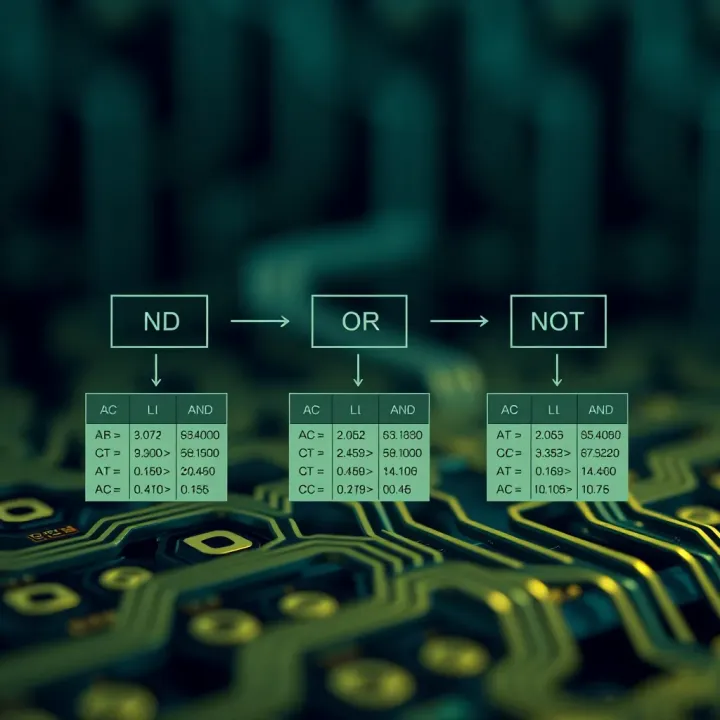
Binary logic enables computers and systems to perform complex calculations swiftly by using basic yes/no decisions at lightning speed.
To give a practical example, consider algorithms that drive automated trading systems. They rely on binary decisions to execute buy or sell orders based on market data, programmed through layers of logic gates. These gates act like switches, controlling the flow of electrical signals to produce outputs matching specific conditions.
This fundamental principle extends beyond finance to many applications, such as encryption for secure online banking in South Africa, error detection in digital communication, and control systems in manufacturing plants.
Understanding the pillars of binary logic provides traders, investors, and analysts a clearer perspective on how digital systems operate under the hood. It reveals why stability in computing resources and data accuracy are vital — since every decision and process ultimately boils down to streams of zeros and ones.
In the sections that follow, we will unpack the operational basics of binary logic, explore common logic gates, and look at how these underpin the high-tech landscape in South Africa and beyond.
Binary logic is fundamental to the world of digital technology, acting as the backbone for everything from simple calculators to advanced computer systems. For traders, investors, and financial professionals, understanding binary logic provides insight into how the devices and software they use daily actually function. This knowledge helps in interpreting technology trends and innovations with greater clarity.
By grasping the principles of binary logic, you can better appreciate the precision and efficiency behind data processing, security encryption, and algorithm execution. For instance, when analysing financial software or automated trading platforms, knowing how binary decisions underpin their operations can clarify why certain outputs or decisions are generated.
Binary logic is a system of reasoning based on two states: true or false, often represented by the digits 1 and 0. In computing, these two values map to electrical signals—high or low voltage—enabling machines to process complex instructions through simple on/off states. This simplicity is what makes digital systems reliable and fast.
In practice, binary logic forms the core of decision-making processes within hardware and software. Every calculation or logical decision a computer makes—such as verifying if an account balance meets certain criteria—involves binary logic operations done on these 1s and 0s.
The choice of binary over other numbering systems, like decimal, is down to its robustness and ease of implementation in electronic circuits. Representing information as two clear states reduces errors and interference, especially important in South Africa's sometimes unstable power environment. This makes binary logic circuits more reliable in handling data in conditions where signal noise or power fluctuations may occur.
Additionally, binary logic scales efficiently. Combining simple binary operations creates more complex functions that power everything from processors to communication devices. For example, the everyday use of mobile banking apps like FNB or Capitec relies on layered binary operations to process transactions instantly.
The idea of using two states to represent information isn’t new. Ancient civilisations, such as the Chinese with the I Ching, recognised duality and coded information in binary-like forms. In more recent centuries, scholars began formalising binary concepts to simplify calculations and logical reasoning.
This early groundwork set the stage for modern binary logic by showing that complex problems could be broken down into simpler, binary-based steps. This principle remains standard in today's digital world, where vast amounts of data are processed through basic binary decisions.
German mathematician Gottfried Wilhelm Leibniz is often credited with formalising the binary number system in the 17th century, demonstrating its potential to represent all numbers using just two symbols. His work highlighted binary’s elegance and practical use in computation.
Later in the 20th century, George Boole's development of Boolean algebra laid the foundation for digital logic circuits. Boolean algebra describes the rules and operations of binary logic using AND, OR, and NOT operations, which are vital in designing electronic circuits used in computers and digital technology.
Understanding these historical milestones helps appreciate how binary logic evolved from abstract ideas into the practical foundation of modern computing, including the devices and software that impact South African financial markets and business.
Understanding the basic principles of binary logic is key to grasping how modern computing and digital technology work. Binary logic provides a simple yet powerful way to represent information using only two states, which is hugely practical for electronic devices operating in South Africa and across the globe. For financial analysts or traders working with complex data systems, knowing the binary backbone helps appreciate how data moves and is processed at the most fundamental level.
At the heart of binary logic is the concept of bits and bytes. A bit represents a single binary digit – either a 0 or a 1 – which can signify off/on, false/true, or no/yes. Bytes are groups of eight bits, which combine to represent more complex data such as numbers, letters, or instructions. For instance, the letter “A” in binary is 01000001. Traders who deal with algorithmic trading systems or digital financial records often encounter these binary units when data is stored or transmitted.

Bits and bytes make computers efficient by using minimal physical resources to encode information. This efficiency is why modern computing equipment, from mobile phones to high-frequency trading platforms in Johannesburg and Cape Town, relies on binary.
While we use the decimal system (base-10) daily, computers operate using the binary system (base-2). The decimal system counts from zero to nine before adding an extra digit, suitable for human use but complicated for electronic circuits. Binary simplifies this by counting only two digits: 0 and 1.
To illustrate, the decimal number 13 translates to 1101 in binary. Since each digit in binary (bit) doubles the value of the previous digit from right to left, the system aligns well with electronic switches that are either open or closed. This difference matters when converting financial data or programming digital tools that operate internally in binary but output results in decimals that users understand.
Binary logic relies on truth values—true and false—which correspond to 1 and 0, respectively. This straightforward concept allows computers to make decisions by evaluating conditions. For example, in stock market alert systems, a set condition like "price > R500" can be expressed in binary terms and help trigger automated trades.
By reducing complex scenarios to a series of binary true/false decisions, programming becomes more manageable, and devices execute operations reliably without ambiguity.
Logical operators form the building blocks for these decisions. The main ones include AND, OR, and NOT, which combine or invert truth values:
AND returns true only if both inputs are true (1 AND 1 = 1).
OR returns true if at least one input is true (0 OR 1 = 1).
NOT inverts the input (NOT 1 = 0).
For instance, a system monitoring if a financial transaction exceeds R10,000 and has been approved by the compliance department uses the AND operator to confirm both conditions before proceeding. These operators plug directly into software algorithms and hardware circuits alike, shaping everything from simple calculators to complex trading bots.
Understanding these core principles of binary logic equips financial professionals and technical users alike to better appreciate how everyday digital systems function reliably and swiftly, even under the pressures of real-time South African markets.
Logic gates are the basic building blocks of digital circuits, crucial for processing binary information. They perform fundamental operations that make it possible to manipulate and make decisions based on 0s and 1s — the language of computers. Understanding these gates helps traders and financial analysts appreciate how digital processing underpins automated systems, electronic trading platforms, and data encryption.
AND, OR, NOT gates are the simplest forms of logic gates, each performing a specific function on binary inputs. The AND gate outputs a 1 only when all its inputs are 1, much like an investment decision that requires all conditions to be met before proceeding. The OR gate produces a 1 if any input is 1, resembling scenarios where multiple opportunities independently trigger a response. Meanwhile, the NOT gate inverts its input; a 1 becomes 0 and vice versa, similar to a toggle switch flipping a status from active to inactive.
How these gates process binary inputs revolves around straightforward rules:
AND gate: Inputs [1, 1] yield output 1; any other combination outputs 0.
OR gate: Inputs [0, 1] or [1, 0] output 1; only [0, 0] outputs 0.
NOT gate: A single input flips from 0 to 1 or 1 to 0.
This simple logic allows traders’ software to execute conditional commands, like buying a stock if the price falls below a threshold (AND), or alerting if any key indicator changes (OR).
More advanced gates, such as NAND, NOR, XOR, XNOR, extend basic logic to perform nuanced operations. The NAND gate outputs 0 only if all inputs are 1, while the NOR gate outputs 1 only when all inputs are 0. These gates are fundamental in creating memory units in computers by storing bits securely.
The XOR (Exclusive OR) gate outputs 1 if the inputs differ and 0 if they match, making it essential in error detection and digital adders. Its counterpart, XNOR, returns 1 when inputs are the same, used in comparison circuits, which can translate to decision-making software verifying if two data streams are identical.
Building complex circuits from these gates involves combining multiple basic operations to perform sophisticated tasks. For instance, a modern processor can have billions of such gates arranged to execute calculations, control signals, and memory functions. In financial systems, these circuits help run algorithms that filter trades, calculate risk, and optimise portfolios in real-time.
Understanding how to connect and manipulate these gates offers insight into the backbone technology powering automated financial tools and digital systems vital for modern trading and investment.
Each gate type plays a specialised role yet links seamlessly to form the complex digital brain behind everyday financial decisions.
Binary logic is the foundation of modern digital technology, enabling the electronic devices and software we rely on daily. Its role in digital systems goes beyond simple on/off signals; it determines how processors handle instructions, how memory stores data, and how software makes decisions. For traders and analysts, understanding these applications reveals the backbone of the tools used for analysis, alerts, and trading platforms.
Processors use binary logic to perform complex calculations and decision-making tasks. At the heart of a Central Processing Unit (CPU), logical operations interpret binary signals—ones and zeros—to execute instructions such as addition, subtraction, or condition checks. This binary code directly controls hardware components, allowing your computer to run trading software or crunch large financial datasets.
For example, a trading algorithm executed on a processor breaks down into binary instructions that the CPU processes step-by-step. The use of binary logic ensures fast and reliable interpretation of these instructions, crucial for time-sensitive tasks like high-frequency trading.
Digital memory, from RAM to solid-state drives, relies on binary logic to store and retrieve information efficiently. Each bit in memory represents either a 0 or a 1, and these bits combine to represent numbers, characters, or instructions. When you save your investment portfolio data, binary logic governs how this information is organised, accessed, and modified.
Memory controllers coordinate the reading and writing of binary data, ensuring accuracy and speed. This process is vital for maintaining the integrity of financial records and ensuring the smooth functioning of business applications.
Behind every software application lies binary logic guiding code execution and algorithms. Programmers write instructions using logic operators—AND, OR, NOT—to control program flow and make decisions based on conditions. This logical structure translates into binary machine code that computers understand.
Algorithms used in financial analysis, like those predicting stock prices or managing risk, depend heavily on binary logic to process input data and deliver outputs. For instance, a system checking if portfolio exposure exceeds a limit uses binary decisions to trigger alerts.
Most programming languages incorporate binary logic operators to build functionality. In languages such as Python, Java, or C++, logical statements control operations like filtering data or executing transactions conditionally. A snippet using if statements combined with binary logic can determine if a trade meets criteria before execution.
Trading platforms and financial software harness these binary logic constructs to ensure automated, precise responses. For example, an automated equity trading bot might use binary conditions to enter or exit trades based on real-time market data.
Effective use of binary logic in both hardware and software ensures that financial tools operate swiftly, accurately, and reliably—a must-have in today’s competitive market environment.
Key considerations for traders include the speed of processing and reliability of data storage, both depending on sound binary logic implementation.
Developers and analysts benefit from understanding how binary logic affects program behaviour to optimise performance.
Ultimately, keenness to grasp these binary logic applications helps stakeholders make smarter decisions about technology investments and risk management in the digital age.
Moving beyond the basics, it's essential to understand how binary logic continues to evolve. These developments not only influence the direction of computing technology but also affect sectors like finance, communications, and data analytics—fields crucial to traders, investors, and financial advisors alike. Staying informed helps you anticipate technological shifts that could impact market dynamics or the security of digital assets.
Recent advancements in hardware focus on making binary logic faster, more energy-efficient, and more compact. For example, South African tech firms and research institutions are exploring the use of quantum dot cellular automata and spintronics, promising alternatives to traditional semiconductor transistors. These innovations can lead to microchips with millions more logic gates packed into smaller spaces, reducing latency and power draw. Practically, this translates to quicker processing speeds for financial modelling, real-time analytics, and low-latency trading platforms.
Besides local research, global improvements such as 3D chip stacking and neuromorphic computing technologies are influencing how binary logic circuits perform. They offer better performance-per-watt metrics, which means your devices — from smartphones to trading terminals — can handle more data without excessive heat or power consumption.
Logic gate design is far from static. Engineers have refined gate layouts for speed and reduced error rates. For instance, complementary metal–oxide–semiconductor (CMOS) technology has become the staple for logic gates, offering balance between performance and power efficiency. In South Africa’s growing data centres, improvements in CMOS-based gate design enhance server reliability and uptime—a vital factor for firms handling large financial databases.
Moreover, researchers are experimenting with novel logic gate designs that harness memristors — resistors with memory — which can perform logic and store data simultaneously. This dual role can streamline circuit complexity, potentially cutting costs and improving performance in computational tasks crucial for quantitative finance and algorithmic trading.
While binary logic forms the backbone of all digital computation today, it has practical limits. For one, binary systems struggle with certain types of problems, such as those involving uncertainty or fuzzy data, which are common in financial risk assessment and forecasting. Traditional binary logic requires clear true-or-false inputs, which can oversimplify complex datasets.
Additionally, as devices shrink to nanoscale dimensions, issues like quantum tunnelling introduce errors, making it challenging to maintain reliable binary computations. South African companies investing in high-frequency trading platforms need to be aware that hardware limitations could impact system stability.
The search for more versatile logic systems has given rise to developments like ternary logic (three states instead of two) and probabilistic or fuzzy logic systems. These alternatives can handle a broader range of data states, aligning better with real-world variability, such as fluctuating stock prices or incomplete financial reports.
For instance, fuzzy logic is already being used in automated financial advising tools and credit scoring models to factor in nuances traditional binary logic cannot capture. Meanwhile, research into quantum computing—still in its early phases—promises a move away from strict binary states altogether, potentially transforming computation by solving complex problems much faster.
Staying abreast of these developments provides financial professionals a competitive edge by understanding how computing advancements can propel more accurate analysis, efficient trading algorithms, and robust risk management approaches.
In summary, while binary logic remains foundational, contemporary strides and future prospects signal exciting transformations that traders, investors, and advisers should watch closely. Their practical implications could redefine how financial data is processed and decisions are made in Mzansi and beyond.
Explore binary translation🖥️, how it lets software run across different processors, its challenges, applications, and future — vital knowledge for SA tech fans🔧.
Discover www.binary basics and how binary numbers & internet protocols shape tech today. Practical tips for South African users to master binary online 💻🌍

Explore binary form in music 🎼—from its roots to variations. Understand its role in composition, practical tips for musicians, plus examples from classical to modern sounds.

Learn how to convert decimal numbers to binary with clear steps, common errors, and useful tools 📊 Perfect for South African learners and tech users.
Based on 6 reviews